Voting in a Nation of Opposition

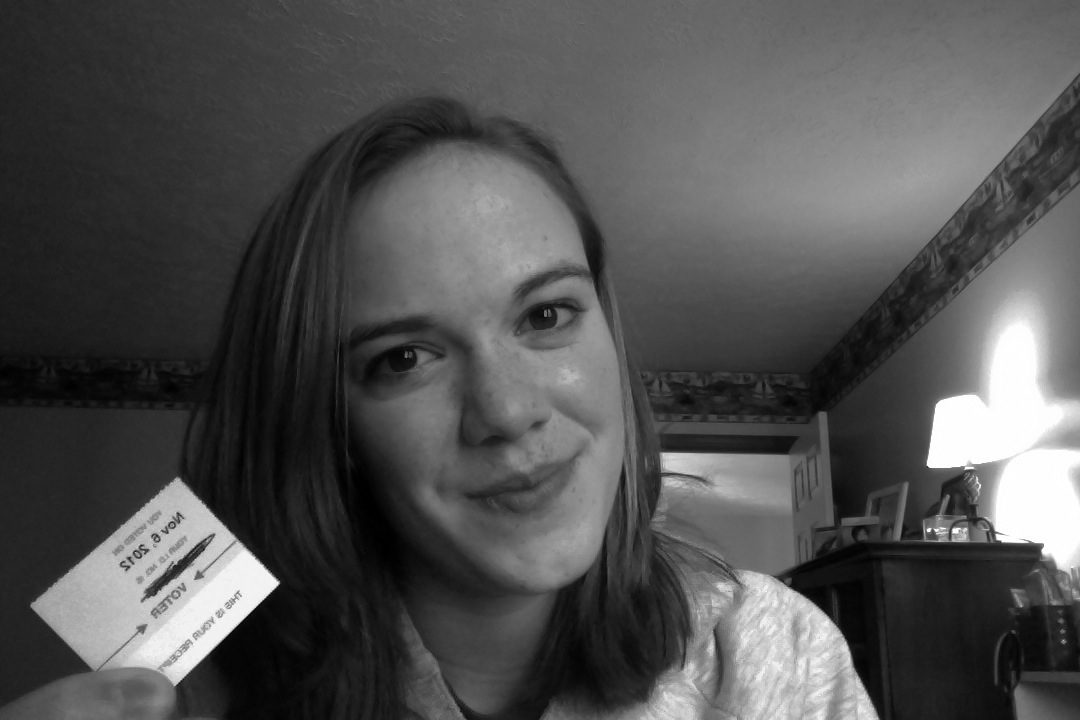
I voted.

I won’t launch into a lengthy diatribe about my political beliefs, or anyone else’s. I just want to tell you that I voted on Election Day.

Yes, Election Day is old news. It’s been days, we already know the results, we’ve already determined our President for the next four years. You might be absolutely thrilled right now or you might be planning your relocation to Canada. Either way, the election has happened; the people have spoken. Hopefully.

Four years ago, I was 18 years old, a college freshman, still ignorant and naive. I registered to vote on my 18th birthday in high school because it was the cool thing to do, not because I knew anything about politics. I registered what I believed was the same party as my parents (not actually 100% sure what that party was or meant or stood for). All I knew was that I didn’t want to be an Independent because I wanted my vote to count.

And then I didn’t vote. I was going to school in a different state and the words “absentee ballot” weren’t even in my vocabulary until it was too late. Barack Obama was sworn in as President and if there were any changes to my personal circumstances, I didn’t know of them. So I was okay with whatever happened.

I’m sure I’m not the only one with a story like this. There are people everywhere who don’t vote, who don’t feel that it will make any difference, who hate the entire system so much that they think not voting will make a statement in itself…whatever the reason, I learned that there is a huge percentage of Americans who don’t vote. So I didn’t feel bad about not voting at 18. In fact, I actually felt better about my decision not to vote because I realized that an uninformed voter is not much better.

Then I took a few political science classes in school and learned a lot more about the government and elections and how that whole “system” works. I learned about political ads and strategies. I learned about the stances that each party takes on issues. I read President Obama’s book and analyzed how race and gender play into politics. I listened and participated in discussions. I saw how the news reports the same story in different ways and influences the way people think about candidates and parties. In short, I slowly became an informed citizen, an active consumer of news–and I couldn’t wait to participate.

So I voted on Tuesday. I woke up early so I could stop by the polling center before I headed to my internship. The voting booths were located in a Catholic school (which I thought was ironic, but maybe that’s just me). I must have arrived at the perfect time. I was expecting long lines, but there were only a few people ahead of me.

As I stood waiting for one person to finish up, a woman suddenly rushed over to me and wrapped me in her arms, thanking me profusely for voting. After only a second of extreme confusion, I realized it was my neighbor. She didn’t even know who I was going to vote for, she was just grateful that I was participating in our government.

When I got up to the table, I was asked for ID (also ironic, considering Pennsylvania does not require ID) and I handed them my license. I saw copies of the signatures of everyone in my family, which was weird to me.  (It felt a little bit like someone was keeping tabs on me. I had never been there before and I didn’t know those people, but they had my signature just chilling in some binder?)

The women behind the table passed along the news that I was a first-time voter, like they were playing the Telephone game or something. My personal political beliefs, which may or may not have agreed with their own, didn’t stop them from being excited for me.

“First-time voter over here, Mary!”

“Oh Sharon, we have a first-time voter, make sure Janice knows.”

“Hey, can you show this first-time voter what to do?”

And so I was led to the last chest-high computer in the row and a kind, little lady showed me how to tap the screen for the candidates I wanted and hit the vote button when I was finished. She reminded me to tap “confirm” when I was finished.  And after I clicked through the candidates and hit “vote” I wondered how anyone could miss the 6 inch by 6 inch “confirm” button in the center of the screen. But I guess people had.

And then it was over. I walked out of the room and back to my car, with a smile on my face and this extreme sense of pride that I had just voted for the President of the United States. I had such an easy time with it that I wondered why everyone didn’t vote. I wondered why people claimed to be too busy, or said the process was too complicated. But I saw the news that night and I saw people who waited hours in lines and had to fill out bubbles on sheets of paper, and I realized that maybe it wasn’t quite as easy for everyone.

Politics often causes such huge rifts between groups of people and communities. They like one candidate, they hate certain policies, they think they know what should be done to make America better. No one agrees on anything and we certainly can’t all agree on everything. But the one thing people should agree on is that it is important to vote. It is important to be a part of it.

I didn’t think it mattered before. I didn’t think that one person’s vote out of millions would make any difference. But a lot of people might think this way. And when we all think we’re unimportant–when we are all uninformed and apathetic–then the system won’t work.

Here in America, we have this freedom to vote. We have more than the freedom to, we have the right to. Not everyone in this world has that. I think it does matter. And now I am proud to say I voted.

Tragedy in Colorado

The news about the shootings in the Colorado movie theater  is like an addiction. It’s like cracking your knuckles. It’s like driving past an animal killed on the street and you don’t want to look but you just can’t help yourself. Of course we are being constantly fed this news by the broadcast networks and CNN. We are updated through every newspaper and all social media outlets. They are forcing this news upon us everywhere, but even if we wanted to, we couldn’t turn away.

This tragedy hits so many levels of our society, it touches upon all kinds of issues that maybe the nation should be compelled to address. Our hearts go out to the victims and their families because it could have just as easily been one of us, or our brother, or daughter, or girlfriend. Every theater across the nation was packed with the exact same kinds of people, filled with costume-clad Batman fans, anxiously awaiting this sequel, excited to tell all their friends about it. Everyone in every theater bought tickets in advance, stood in line for hours, bought popcorn and flooded these theaters. It could have been any of us. We were all in theaters that night. That’s why we can’t turn away.We hear the victims’ stories and our hearts cry out for them and we just can’t imagine what kind of person could do this, especially the person with that infuriatingly satisfied smile on his face that we see plastered all over TV’s and newspapers.

Twelve people have been killed, and 58 injured. This mass shooting has been compared to the shooting at Columbine High School in 1999. It is the result of a sick person buying weapons and ammunition legally and easily and deliberately walking into a crowded theater and firing at people who had limited ways of escape. Maybe some things need to be re-evaluated in the wake of this tragedy.

The biggest issue that has been raised in the news is that of gun control. Journalists and politicians are saying that Obama and Romney should now have to address this issue in detail and take a public stance. On the one hand, it seems that the government should restrict gun ownership. Right now, we are giving guns out to people who obviously shouldn’t have them. The other side of the coin is that it is our Constitutional right to own guns and be able to defend ourselves. This may be, but so many people will be buying guns for self defense and firing away that we’ll just end up with more innocent casualties. Such laws like those in Florida where the Trayvon Martin shooting occurred not too long ago, allow people to shoot and kill if it is in self-defense and they’re in fear of their lives. But whose word do we listen to?

Perhaps gun licenses should be controlled just as alcohol is controlled. We are allowed to drink alcohol in the U.S., and the government can’t tell us not to. But we have to wait until we’re 21 and there are rules even after that. You can’t buy alcohol for minors, you can’t drive under the influence, bars are allowed to cut you off if you’ve had too many. Maybe people should only be allowed to have one gun and only a limited amount of ammunition. If you have a gun for self-defense, you shouldn’t need more than a few bullets–certainly not 6,000 rounds of ammunition.

Last summer, as a news intern, I sat in on the trial of a young man who killed three police officers. I watched the court go through every piece of weaponry he had in his home and was appalled. The sheer number of guns and amount of ammunition led the court to believe that the act was premeditated, along with other evidence, and I believe that is what we can assume from the Colorado shooter. No normal, sane person needs so much weaponry and I believe this needs to be regulated in some way.

A smaller issue that this shooting might bring up is the subject of violence in the media. Is violence and killing a direct result of seeing violence in movies and video games, or hearing violent song lyrics? Advocates of the direct effects of media might say yes. Children are taught from a young age that people shoot and kill each other in movies and games–why not in real life? Kids imitate things they see on the screen, they act out battles and fight with pretend weapons. Maybe this is only pretend for so long before they might try it out in real life. Opponents might say that all kinds of children see violence in the media and yet very few of them actually imitate this violence in real life. Whatever the case may be, this Colorado shooter may have been acting out his Batman fantasy, saying he was the Joker and proceeding to inflict harm on innocent people.

Underlying all of this is the societal issue that we as Americans apparently raise, teach and allow people to shoot and kill other human beings. We have a moral crisis at stake here. Crime is everywhere, even if it hasn’t been headlined in the news. Where did any person get the idea that it is okay to take another human life? What kind of morality is being promoted in this country?

We have politicians who are overly concerned with their campaign finances and advertisements, spreading rumors about each other and mud-slinging, just to win the “race.” We have public officials who are distracted by gay marriage rights, as if that pertains to anyone but the two people involved. We have news outlets that are sidetracked by celebrity scandal.

There are some things that are distractions, sensationalized pieces of news, and there are other things that are worth the addiction. We should take notice when we see a story that we can’t turn away from, when we can’t turn off the TV because we can’t believe something this horrible could happen. Maybe that’s our wake-up call, the red light going off telling us something is wrong and needs to be changed. Because how else could we keep watching this tragic coverage over and over and not want to fix it?

The Global Reality of a Media World

I read an opinion column today in the Pittsburgh Post Gazette about the state of the world discussed at Rio+20, in terms of carbon emissions, climate change, and sustainable development. The author, Jeffrey D. Sachs, and those at the United Nations Conference, call for an end to extreme poverty, less carbon emission from the energy system, slower population growth, sustainable food supplies, and protection of the environment. But those of you reading this, who probably have at least six other tabs open on your screen, switching from Facebook to Pinterest, updating Twitter on your phone, while texting your friend, are probably nodding your head in agreement, thinking yes, it’s probably a good idea to save the world, yet how many of you got up to turn a light off? How many of you have the TV on while you’re on your laptop, reading blogs and updating social media, obviously not even watching the TV? I admit, I have the TV on. I like having the Today Show on in the background of my morning and if something interesting stands out, I turn my attention to the television.

This is the reality of the world today. People are perpetually connected and plugged in and so immersed in their personal lives and the virtual lives of their friends. People would rather “pin” a link to their dream wedding dress and tell hundreds of Twitter users that the line in Starbucks today is incredibly long than shut off their technology and plant trees. I’m not saying that all people are like this, but this is our reality.

On the other hand, our reality is also high carbon emissions and global warming that eventually will destroy the planet. This is what scientists tell us, but so many people don’t believe it or don’t want to believe it. These claims seem extreme. People just aren’t motivated to look outside their own neighborhoods. We say we want what’s best for our children and no one can deny that. But our ability to look far ahead, hundreds or thousands of years is limited. We see the reality that is right now and right now the sun is shining, the grass is growing, the birds flit around the backyard. Right now the kids have enough to eat and go to great public schools. Right now, I can’t afford a new energy-efficient vehicle, but that’s okay because there’s enough gas in my car, and GetGo and Giant Eagle are helping me save a few cents at the pump. The concern about overpopulation, famine and disease in third world countries doesn’t hit home because, well, we can’t see them. All we see are the sad, slow-mo advertisements on TV telling us to donate just 25 cents a day, but everyone thinks those are over-exaggerated to draw a few more quarters from the crowd.

So what can be done?

If we can’t get everyone to agree on the current state, how can we possibly expect people to agree on the measures that must be taken?

So many people are calling for action from the younger generations. The recent college graduates, like myself, and the students. Treaties and “Sustainable Development Goals,” while great in theory, won’t work unless the information and the impact somehow resonates with the young, tech-savvy, Facebook-stalking, status-updating crowd. So how do we make it resonate? As a communication major, passionate about media, TV, video production, I am a firm believer that media can reach people in ways that newspaper articles and politicians can’t. The only problem is that even media may not always work. You might remember the KONY2012 video that almost instantly went viral with almost 1 billion viewers on YouTube. This video resonated with me and probably hundreds of thousands of others. But it did not resonate with everyone. The video was a big topic of discussion in my college media and politics class and it is up for debate why this video was such an instant hit and then almost just as quickly fell from the spotlight. I’m sure it motivated some people to buy the bracelets and post signs and this kind of enthusiasm is what we need to save the world, all the time. (But that’s another topic.)

So when you think about how to reach the audience, the young internet generation, a YouTube video might work. Or a Facebook page, or a Twitter account, or a blog post. A story on the 6 o’clock news might work, or the endorsement of pro athletes and celebrities. But really, it’s going to be all of that and more. The world won’t change just because someone writes a blog post, or a newspaper column. It won’t change if someone makes the most creative 30-minute YouTube video of the year. It won’t change if politicians put it to a vote. In Sachs’ article he writes, “Since politicians follow public opinion rather than lead it, it must be the public itself that demands its own survival, not elected officials who are somehow supposed to save us despite ourselves.” The public will only demand change if we all agree. The whole world needs to agree. We will only all agree if we are inundated with the information, if we are convinced through all outlets that this is the change we need to see.

We see evidence every day of technology becoming better and people wanting to use it. Take Apple. They could come out with a new, faster, better product every month (oh wait, they do…) and people buy it and use it and promote it. People want better things, they want to be on the edge of innovation. We wouldn’t have students majoring in engineering and science if this wasn’t true. We just need the motivation to convince the world that sustainability is what’s better. That energy-efficiency is what’s better. That everyone’s lives will be better if we all adopt this world-saving technology and practices. I hope that this blog post will add to the global conversation. Hopefully others will continue to flood all media with the facts and someday soon, maybe we’ll all agree.

Apathetic Citizens–Unite!

People might be spending more time with social networks and entertainment programs, but they still manage to unite for a common interest.

According to the theories of selective exposure, perception and retention, people either avoid information that is incongruent with their own beliefs, or if they do view this information, they consume it through biased eyes or remember only the parts that adhere to their beliefs. Earlier in the year, we also talked about how people seem to be paying less attention to hard news, and a new genre of infotainment is becoming more prevalent. People are actively choosing to watch the Daily Show, for example, because they agree with John Stewart’s more negative criticisms of politicians and governmental practices, or at least find him entertaining. If this is the only “news” people view, we would say that they are only exposing themselves to the ideas that already fit with their beliefs. It is widely known that conservatives watch FOX news and liberals watch CNN and MSNBC. Even on these generally hard news sources, we can see some evidence of infotainment. One of CNN’s recent tweets today was “Do allergies actually benefit your health?” One of the stories on the U.S. news page of MSNBC was “Teen banned from prom over Confederate dress.” On the ABC News home page, “Katherine Heigl adopts second baby.” And even on the home page of FOXNews, “Does the G-spot exist? New study fuels debate.”

We can speculate, then, that even though these are traditionally hard news sources, they are finding that people like infotainment. People like to be entertained and with so many other outlets to find entertaining information, games, and social media, the hard news sites are just trying to keep up and compete. Remember, news is a business.

So scholars argue—are people becoming apathetic? Are people becoming less involved in the governmental process and less knowledgeable about important issues? According to Facebook’s newsroom, there were 845 million active users at the end of December 2011. According to a Time Magazine articlein September 2011, there were 100 million active Twitter accounts, with an average of 230 million tweets per day. According to Wikipedia, television ratings showed that in 2008, The Daily Show had 1.45 to 1.6 million viewers daily.

With these statistics, it would certainly seem like people are turning more and more to media that can entertain, especially media that is available on mobile devices, and has quick and easy access. So are these scholars right? Do people care less about what’s going on in the world and more about what’s going on in their world?

I would argue that while so many people are turning to Facebook, Twitter, and entertainment TV shows, the media still has the power to move people to action. Even those who selectively choose the media that they watch decide what is important to them and they are moved to act on it. People who may appear so apathetic in their TV show choice and entertainment value still do care about the world around them.

For example, the MSNBC website prominently displays a headline reading “Autistic boy wired up to show teacher bullying” with a video next to it. In this video, a father is outraged by the abuse his son endured at school, which he secretly recorded, and he posts a YouTube video displaying his feelings and several of the recordings. This video post led to the school firing this boy’s teacher. The video has about 1.5 million views. On the page, there is a petition that sympathetic viewers may sign to show their support for the father and his son and to try to change New Jersey legislature so that teacher who bully students are immediately fired. This petition has been signed by over 85,000 people.

Another example of people stepping up as active participants comes from a story on FOXNews this morning about the Arizona immigration law Senate Bill 1070. Immigrants and pro-immigration activist groups are taking a stand today and protesting what they believe is a discriminatory law, a continuation of their protests two years ago when the bill was signed.

And finally, we see millions of people step up and rally behind Presidents, rally behind Presidential candidates, rally for low interest rates for students and the death of Osama bin Laden. Even recently on the University of Delaware’s campus, where a few years ago, the students here were known notoriously as apathetic, the students have become more involved; they left their houses in the middle of the night to march to Memorial Hall. The students here rallied for justice in the Trayvon Martin case. People may enjoy connecting with their friends on Facebook and they may like to see what their roommate has to say about her exam on Twitter. People might find John Stewart humorous and they might not want to look for every angle of every story every day. But when they find something they care about, many people in this country find a way to become active members of the community. Whether they are signing an online petition against teacher bullying or passing along the message about KONY2012, many people are still finding ways to be informed and be engaged. And while, their selective exposure, perception and retention might skew their information and might make them slightly biased, I think the most important part is that they found something. 

Citizen Journalism and Social Media

This a blog post that I wrote for my Communications class a few weeks ago. The class, taught by Professor Lindsay Hoffman, was an introduction into analyzing how the media and politics work together to form what we know as “political communication.” Prof. Hoffman featured several students’ entries from our class on her blog for The Huffington Post.

Here is what I had to say about citizen journalism:

In this age of expanding internet and social media, more people are turning to online sources for their news. It’s faster, easier and more convenient when we are already perpetually connected. This also requires news outlets to produce news content at an unprecedented rate. News organizations are constantly competing to be the first to break a story, if not the only ones to do so, and it’s very convenient that Twitter’s “retweet” button allows for quick and vast dissemination of any piece of information. It is just this exact tool that also gets news outlets into trouble as we can see with the false breaking news that South Carolina’s Governor, Nikki Haley, would soon be indicted.

An article in the New York Times details how the unfounded information, posted on a small blog, called the Palmetto Public Record, went viral after just about twenty minutes. In the race to be first with information, the blog article was reposted by several news organizations, including major news outlets like the Washington Post. With tens of thousands of followers, the false information quickly spread across the nation and cyberspace. News organizations made corrections later, but the damage to Haley’s reputation was done.

We’ve discussed in class that multi-media is becoming more and more popular, especially online sources such as Twitter, where consumers can get news in 140 characters or less. This is especially appealing to the public as iPhone and iPad sales increase and computer screens are made even smaller. Social media sites like Twitter and Facebook also allow for the public to feel that they are more a part of the news process by promoting “retweets” and “likes” so that friends and followers can stay up to date on the news as well.

The trend of this so-called “citizen journalism” becomes more popular with blogs and Twitter because we know that realistically, news correspondents and journalists can’t be everywhere, covering everything. We have come to rely on this citizen journalism to fill us in on the things that major news organizations miss and to fill the holes with on-the-scene footage and pictures. Major news channels and TV networks, like CNN and NBC ask the audience to send in photos of storms, for example, or if they “see news happening” to call the hotline. As a society, we have come to accept this and we trust the major news outlets to filter out the information and present what is real and true in an unbiased way. But this takes time and resources—things that journalists can’t afford if they want to stay on top and keep their ratings higher than anyone else’s. This is all part of the politics of the media. The ideal of the news is to report events objectively, but the reality is that news needs to appeal to the audience in order to get viewers and readers and to stay in business.

This leads us to stories such as Haley’s false indictment reports. News outlets and citizen bloggers are so anxious to get the news and spread the news—especially when it is scandalous and sensational, two things that make a story newsworthy—so the fact-checking and filtering stops. It is natural to say, next, that journalists are humans and as capable of making mistakes as anyone else. But the ease and speed of social media dissemination leads to grave errors, spread to tens of thousands of people. So where do we draw the line? Is citizen journalism only valuable to the public up to a point?

We recently discussed in class that the media have the ability to frame the way the public sees the story.  A story can be framed in many different ways, depending on the context and the word choice and language used. There is no story written that was not written with some kind of frame. This goes along with the notion of bias that we talked of earlier in the semester as well. Journalists are required to present the news objectively, without bias. But there is rarely a case where there isn’t at least a little bias. As we also said, there is no one “truth,” there is only the truth as we see it, and each person sees it differently. So who is to say that the way the citizen journalist sees a story or event, is worse or less truthful than the way the New York Times journalist may see the same event? This is what advocates of citizen journalism may say.

However, we also know that journalists at news organizations have been trained to check facts and examine all possible known sides of a story. Citizen journalists on the other hand, have not, and their blogging and tweeting therefore cannot and should not be evaluated on the same level.

We saw the detrimental effects of social media news dissemination when Joe Paterno’s death was falsely reported and reposted by and to millions on Twitter. The New York Times wrote an article afterwards explaining the mix-up and what followed as they tried to make sense of the power of social media.

Social media outlets allow for non-journalists to post and repost “news” or even just commentary and false information can go viral all too easily. While social media sites are admittedly a growing outlet for news, the information must be critically evaluated before it can be noted as “truth.” Many citizens do not have the knowledge to read news critically and to accurately make a judgment on its authenticity. Until all citizens can effectively evaluate information on social media sites themselves, there is no way that we can use Twitter and Facebook as effective tools for “citizen journalists.”